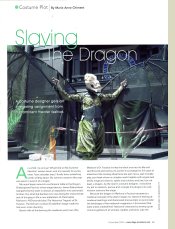
 Bored with all the learning the medieval world can offer, Marlowe's Dr. Faustus invites the black arts into his life and sacrifices his eternal soul to Lucifer in exchange for 24 years of adventure. His ensuing adventures are part circus, part morality play, part freak show--a complex world replete with angels and devils, kings and clowns, spirits and scholars and last, but not least, a dragon. As the team's costume designer, it would be my job to research, pursue and wrangle this dragon into submission and onto the stage.
---Stage Directions---
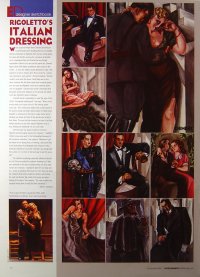 Chiment says she always wanted to costume Rigoletto and thoroughly enjoyed her research. "I watched 1930s movies and went to the Metropolitan Museum of Art's costume collection," she explains. "Whenever I got my hands on actual piece of clothing, I just poured over it and took plenty of photographs and measurements. I immersed myself so much that I felt like I was living back then, which, in my mind, is the best way to get into a project."
The costume renderings were also influenced by the era, as Chiment created the costume drawings as if they were portraits in the style of quintessential art deco artist Tamara de Lempicka. "I wanted to take the next step and do a series of paintings that would do more than just show the costume shop how to build the clothes, but to show the cast and director the mood of the piece and give a feeling of the opera," she explains. "The cast certainly has enjoyed having them to help find their characters."
---Entertainment Design---
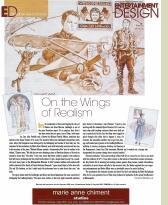 The costumes for this production, by Marie Anne Chiment, were both historically accurate and also true to the emotions of the piece. "[The director] wanted a 'documentary film' level of realism in the clothes," Chiment says. "We felt that we were bringing a piece of American history to life and we wanted to honor that." She adds, "I was very aware that there would be people in the audience that had known Lindbergh and they would write letters if I got a single detail wrong! I gave myself time to fall in love with 20s and 30s fashions, so that I could teach the performers how to make them their own," she adds. "I spent a year working with the talented Opera Theatre of St. Louis costume shop staff creating costumes that were both correct to period yet hid the fact that they were rigged for quick changes that often had to happen a vista."
---Entertainment Design---
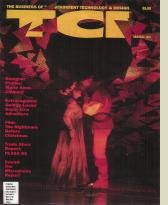 The set design is an integral part of Chiment's concept, which draws on various ideas from pre-Enlightement scientific and occult practices. "I was looking at tarot cards and ancient astrologers," she says, "the whole idea of medieval scientists and priests, men who wanted to find out about nature with a very limited amount of scientific tools. I read Kepler and all these ancient astrologer-scientists and looked at Leonardo da Vinci's sketch books. My favorite sets are moving organisms," Chiment reflects, "because you don't know from moment to moment what will happen. That makes it a little dangerous, which is important to me."
---Theatre Crafts International---
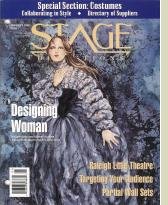 "I'm always designing in my head and I'm always shopping," she explains. "I'm always looking for ideas. I tuck them in my head and store them up. I keep files of swatches, research, paint chips, articles, pictures, objects. Because when a project comes along it may not speak to me right away; I may have to go to my idea folders--a seashell whose shape I liked, a bird feather with an odd color, a photograph--to stimulate my ideas." She also haunts the fabric stores. "I find out what's available this season, and I take swatches. If I find the end of a bolt, I may buy and store it. I look all over New York, and when I'm in a new city I look there, too. Because somewhere out there is lurking that perfect fabric."
---Stage Directions---
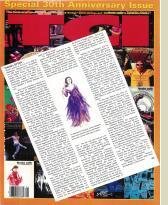 In her researches, Chiment learned an important rule of biology: to ensure their survival, poisonous plants broadcast their own warning by being visually striking. Taking this as her cue for Beatriz, she created a breathtakingly beautiful gown constructed of painted organza petals. "Hawthorne tells us that Beatriz's favorite flower is purple. With this in mind, I chose the iris for her color palette. I was fascinated by the way its outer petals are purple and veined like human skin while the inner heart of the flower is bright yellow. Her gown was constructed like a flower, with petal overlaying petal. At the deepest level of all the poisonous purple is a flash of sunshine--Beatriz's inner purity."
---Theatre Crafts International---
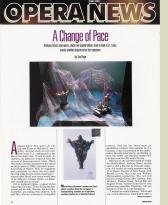 "One of the beautiful things about science fiction is that you make your own rules," adds Davis. "Anything can happen, you're not bound to the rules of Earth. But Deborah hasn't written that sort of cold-blooded, technological kind of science fiction. Under the Double Moon is set in a small, very human situation, in a world beyond technology, in a fishing community, a place that isn't developed in traditional sense. Yet the characters have these extraordinary telepathic gifts, so it's obvious there has been development, but an untraditional development." Right now, however, Davis is still thinking mainly about the planet Undine: "Wait till you see the ocean we're [set and costume designer Marie Anne Chiment] building for St. Louis!"
---Opera News---
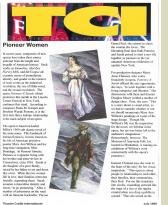 "This opera is about people in relationship to each other, their families, their communities, their God. For me this translates into circles, expanding outward like the rings of a tree or the ripples created when you drop a pebble in a pond." Thus she siezed on the concept of water and wood. "Water is important because it represents Patience, a watercolorist and an Aquarian in birth and spirit. Sarah earns her living chopping wood and wood symbolizes her strength and vitality." Chiment continues the themes of water and wood in the set design, "I've designed a unit set to suggest the virgin forests of early America; the trees are stylized to suggest women's bodies in silhouette. In this way, the trees become silent witnesses to American history and women's history as it unfolds onstage."
---Theatre Crafts International---
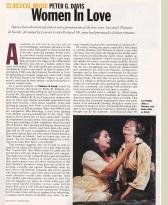 So a warm welcome to Patience & Sarah, words by Wende Persons and Music by Paula M. Kimper, presented by American Opera Projects and Lincoln Center Festival 98. The opera is based on a 1969 novel by Isabel Miller, which tells of two Connecticut women who meet in 1816 and, despite inevitable opposition from both their families, settle down together, living and farming in upstate New York--a tale loosely based on the real lives of folk-art painter Mary Anne Willson and her companion, Miss Brundage. Patience & Sarah enjoyed a modest but affectionate production staged by Douglas Moser and designed by Marie Anne Chiment, whose flavorful sets evoked a rural New England long passed.
---New York---
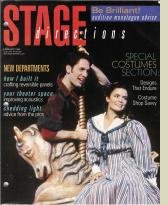 "I recently designed the costumes for the Oregon Shakespeare Festival production of Tom Stoppard's Rough Crossing. I learned from the producer that the show ran in rep with several other shows for nine months for a total of 110 performances. Early production meetings with the director and choreographer helped me grasp the full extent of the show's physical humor. In addition to the clowning, singing, and dancing, since the entire show takes place on board a steamship, one character winds up in the drink. The actor originally was to be carried soaking wet onto the stage after his dive overboard, but rather than ruin his beautifully tailored suit, I had him carried on wrapped in a blanket with only his hair actually wet. Our compromise saved not only the cost of a duplicate suit but was much more comfortable for the actor."
---Stage Directions---
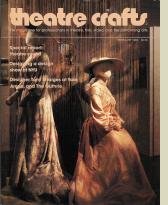 And Marie Chiment was hired by Zelda Fichandler to design costumes for the recent Arena Stage production of A Midsummer Night's Dream.
---Theatre Crafts---
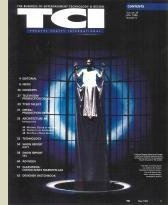
Costume designer Marie Anne Chiment created over 80 period costumes for A Winter's Tale including an elegant silk gown for the narrator.
---Theatre Crafts International---